
International Holocaust Remembrance Day:
A Critical Look at the Red Cross during the Holocaust and the Israeli-Hamas War

International Holocaust Remembrance Day: A Critical Look at the Red Cross during the Holocaust and the Israeli-Hamas War
On International Holocaust Remembrance Day, let us delve into history, where sleeping deep within the annals of the history of the Holocaust, is a story most people aren’t familiar with — a tale obscured by the deliberate embellishment of the Terezín concentration camp, entwined with an intricate cover-up orchestrated by both the Nazis and the Red Cross. Terezín, also known as Theresienstadt, nestled in former Czechoslovakia, served as a linchpin in the Nazi death machinery. It functioned not only as a concentration camp but also as a transit point for deporting Europe’s Jewish population to other harrowing destinations.
Approximately 150,000 Jews were sent to Terezin, including 15,000 children and 33,000 souls succumbed to malnutrition and disease within Theresienstadt’s confines, while over 88,000 individuals endured months or even years of incarceration before facing deportation to extermination camps. Yet, nestled in the heart of this macabre chapter is the largely unknown saga of the Nazi deception — a grotesque charade that unfolded within the walls of Terezín.
In 1944, pressured by international outcry and diplomatic appeals from Danish and Swedish diplomats concerning the fate of their Jewish citizens, the Danish Red Cross initiated an investigation into the 466 Danish Jews deported to the ghetto in October 1944. In response, the Nazis, unwilling to allow an official foreign visit in the squalid conditions of the Terezín ghetto, embarked on an elaborate cover-up.
A meticulous “beautification” program, spearheaded by the SS and carried out by the Council of Jewish Elders and the camp’s “residents,” transformed Terezín into an illusionary spa for the elderly. The Town Square, once a scene of despair, was adorned with new grass, flowerbeds, sand paths, and new trees. An entirely new pavilion, infant’s playground, and even a swimming pool emerged, while dressing rooms and showers were erected. The facade extended to storefronts filled with merchandise from confiscated luggage, creating a surreal semblance of normalcy.
The Nazi charade reached its apex with the creation of a fake currency and bank, a concoction designed to convince Red Cross delegates that they were witnessing a thriving Jewish settlement. Portraits of a falsified Jewish administration were presented in advance to the delegation, and Jewish members were explicitly instructed not to salute SS officers. The camp’s population once ballooned at its peak to 53,264 and was selectively reduced to 27,702 “residents” to maintain the illusion of normalcy, with the rest dispatched to Auschwitz.
On June 23, 1944, the Red Cross delegation, including Frans Hvass of the Danish Foreign Office, Dr. E Juel-Henningsen from the Danish Ministry of Health, and Maurice Rossel representing the International Red Cross Berlin Office, commenced their inspection. Guided by a Jewish Elder named Eppstein, impeccably attired in a frock coat and hat, they embarked on a limousine tour through the transformed concentration camp.
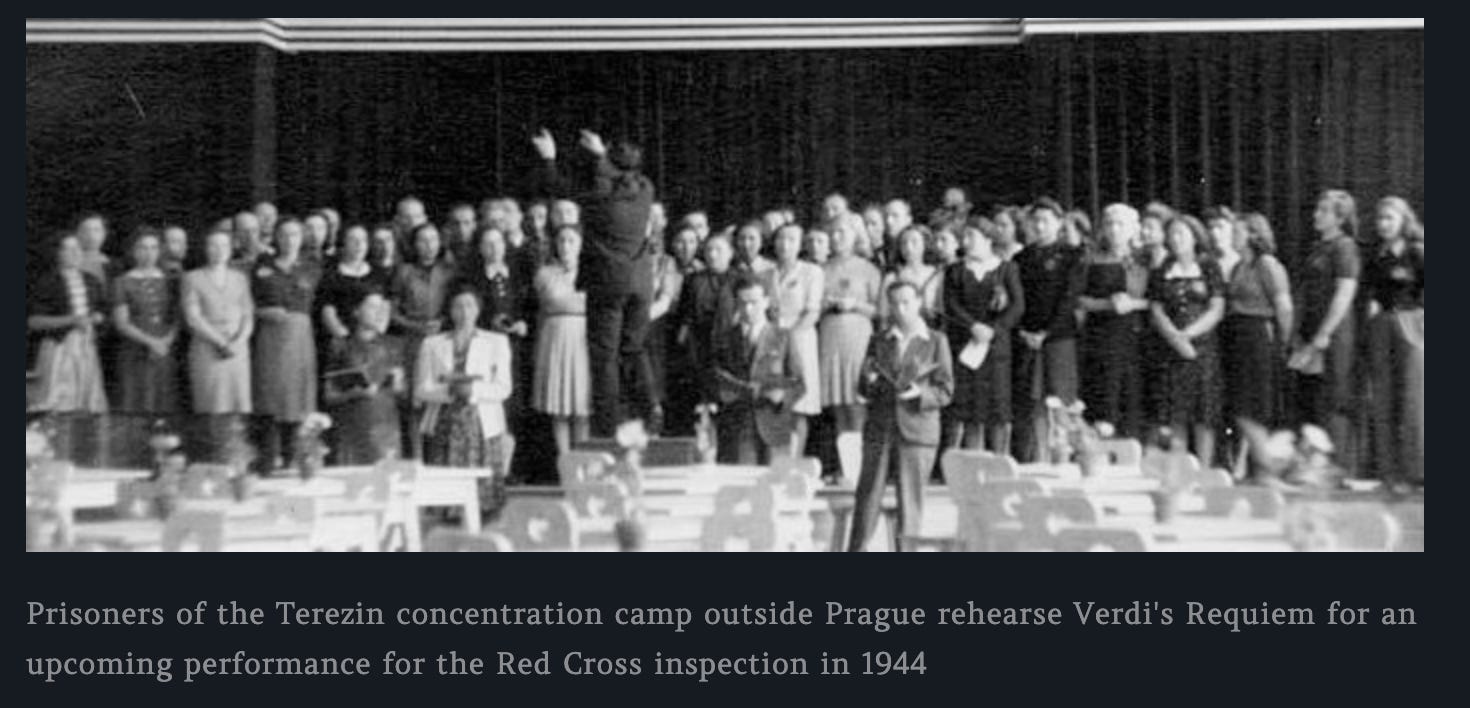
For five hours and forty minutes, a surreal spectacle unfolded as the delegation, accompanied by six SS officials, meandered through the camp. From a rehearsed performance of Verdi Requiem to a mock trial and orchestrated scenes of everyday life, Terezín became a grotesque theater of Nazi propaganda. The inhabitants, coerced into roles assigned by officers, played out a tragic farce that culminated in a propaganda film perpetuating the lie.
In the aftermath of the elaborate inspection, two Danish representatives and the Swiss envoys of the International Commission of the Red Cross meticulously crafted their reports. Despite the spectacle that unfolded during their visit to the Theresienstadt concentration camp, signs emerged — subtle yet discernible — that should have hinted at the stark reality lurking beneath the facade of the orchestrated show.
These signs, duly noted in the reports of the Danes and Dr. Rossel, revealed a nuanced awareness of the peculiarities affecting life within the camp. Conversations with Danish prisoners yielded revelations, as one inhabitant, when asked about the duration of their residence in such seemingly idyllic quarters, replied, “Since yesterday.” The elusive mortality statistics and Rahm’s conspicuous disregard for the request raised doubts. Dr. Henningsen’s inquiry about the maternity ward was met with a nonchalant denial from Eppstein, who claimed it was not part of the tour, citing its nonexistence.
In a rare moment free from the presence of Nazi guards, Dr. Rossel questioned Eppstein about the camp’s future. Eppstein’s ominous response, “I saw no way out,” hinted at an acknowledgment, albeit cryptic, of the dire circumstances within. The post office employee, unable to justify the abysmal state of shipments and communication with the outside world, and the pharmacist, offering only a quizzical look in response to Rossel’s request to view Red Cross-sent medical supplies, added to the growing mosaic of questionable signs.
Despite these indications, the Danish representatives, in a report titled “Jewish Paradise on Earth,” expressed amazement at the apparent success of the Jewish “administration” in improving living conditions within the camp. They dispelled rumors of forced labor and lauded the camp’s supposed achievements. However, their favorable portrayal was marred by misinformation fed to them by Eppstein, who scripted false narratives at the command of SS officers, including allowances for pregnancy and contraceptive use, the absence of widespread undernourishment, and the inflated value of Ghetto money.
The consequences of the Danish reports were profound. The Danish Red Cross, reassured by the glowing accounts of Hvass and Henningsen, ceased pressuring the German government for a visit to other labor camps. This shift in stance inadvertently paved the way for the tragic plan to gas those at Camp Birkenau. Furthermore, the Danish reports influenced an article in the Danish Press Service, spreading more favorable thoughts on Nazi policy and alleviating concerns among members of the Danish government and Red Cross regarding the Jews’ condition.
In this context, it’s crucial to acknowledge that Denmark was under Nazi control at the time, inevitably coloring public opinion with a bias toward Nazi policies. However, Maurice Rossel’s report emerged as the decisive factor, representing the “nonpartisan” International Red Cross and influencing public perception and actions.
In the wake of the elaborate charade, a chilling turn of events unfolded. On September 27th, Eppstein, a key player in the orchestrated illusion, was executed. Alongside this tragic act, 18,401 “residents” were ruthlessly shipped off to Auschwitz. The youngest among them, the children, bore the brunt, with a staggering death toll of the youthful population meeting their untimely demise leaving only 150 children alive. By November, a mere 11,000 souls remained within the desolate confines of Theresienstadt, clinging to the edges of survival until the Allied forces rescued them.
Eight decades later, the echoes of history resound with a haunting familiarity. The Red Cross, a purported guardian of humanity, now serves as a stark reminder that while history may not repeat itself, it does indeed rhyme. In the current unfolding drama, the hostages languishing in Gaza bear witness to 112 long days of isolation, devoid of the solace of a single visit from the Red Cross. Scenes from the hostages being returned show a macabre performance of the hostages giving high-fives to Hamas terrorists and being forced to say on camera they were taken care of and treated well, while the remaining hostages remain deprived of medicine, communications, and the reassuring embrace of familial support.

Confronting the present, one cannot escape the disquieting realization that the past remains un-atoned for. The Red Cross, entrusted with the care of those persecuted in history, now stands accused of neglect, mirroring past transgressions. The haunting specter of nefarious cover-ups, reminiscent of the treatment of Jews entrusted to their care in the darkest chapters of history, casts a shadow over the organization’s moral standing. As we navigate this disconcerting rhyme of the past, the question lingers: Have we truly learned from the echoes of our shared past, or are we destined to repeat the sins we claim to have left behind?
Sources:
https://www.terezin.org/the-history-of-terezin
Theresienstadt: Red Cross Visit
Learn more about the Danish Red Cross visit to Theresienstadt and the Nazi attempt to clean and hide the true…encyclopedia.ushmm.org
https://vurj.vanderbilt.edu/index.php/vurj/article/view/2755/1167
Theresienstadt
In response to growing international awareness of Nazi atrocities, the Nazis decided to allow a Red Cross investigation…encyclopedia.ushmm.org
Additional reading:
https://thehistorypress.co.uk/article/theresienstadt-paradise-camp
Red Cross Admits Knowing of the Holocaust During the War (Published 1996)
International Committee of Red Cross releases copies of its World War II files, some of which provide verification that…www.nytimes.com